
Metal casting and machining are two popular manufacturing technologies that are used in the automotive, aerospace, electronics, and industrial machinery sectors to manufacture metal components. While both processes produce components, they have several differences in terms of how the material is shaped, the tools needed, the costs, and the precision that can be obtained.
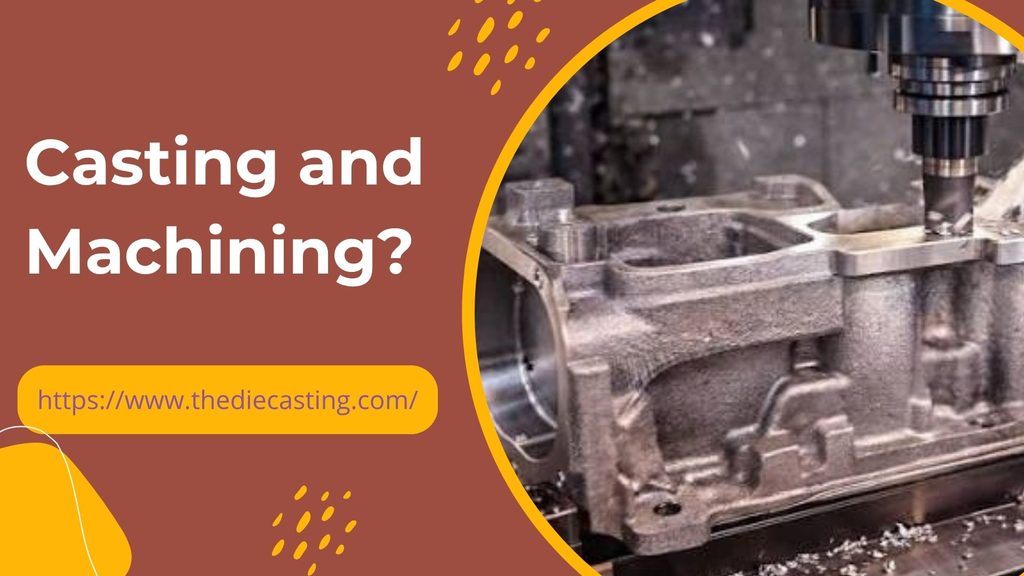
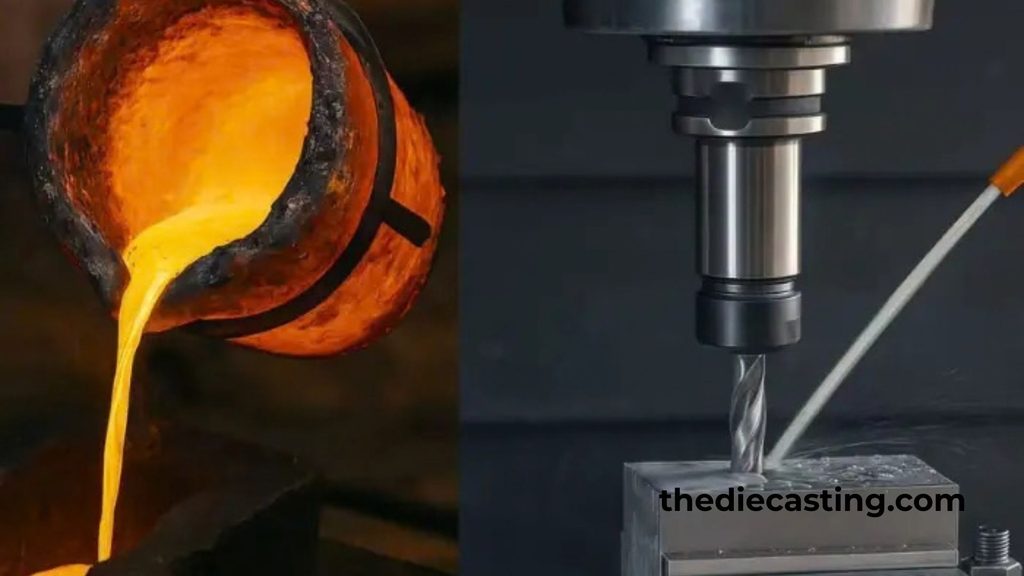
Casting is a process of pouring or injecting molten metal into a mold to form components, and machining is a process that uses cutting tools to remove material from a solid object. In some applications, it is efficient to combine casting and CNC machining of complex parts, which have precise functional features.
What Is the Difference Between Casting and Machining?
Casting and machining differ primarily in their material-shaping methods.
Casting vs. Machining: Key Differences
| Factor | Turnare | Prelucrare CNC |
| Procesul | Molten metal is shaped in a mold | Material is removed from a solid workpiece |
| Scule | Requires molds or dies | Uses cutting tools, fixtures, and CNC equipment |
| Geometry | Suitable for complex shapes and internal cavities | Produces detailed features, subject to tool access |
| Precizie | Depends on casting method and process control | Generally capable of tighter tolerances |
| Finisaj de suprafață | Varies by mold and casting method | Controlled through tools and machining parameters |
| Deșeuri de materiale | Often relatively low, though runners and gates create scrap | Produces chips and removed material |
| Initial cost | Mold or die costs can be substantial | Setup, programming, and tooling costs vary |
| Production volume | Often suited to medium- and high-volume production | Flexible for prototypes and low-to-high volumes |
| Design changes | Mold modifications may be costly | CAD/CAM and toolpath changes are often more straightforward |
| Aplicații | Housings, engine blocks, brackets, and complex parts | Shafts, precision housings, plates, and components with critical dimensions |
How Do Casts Work?
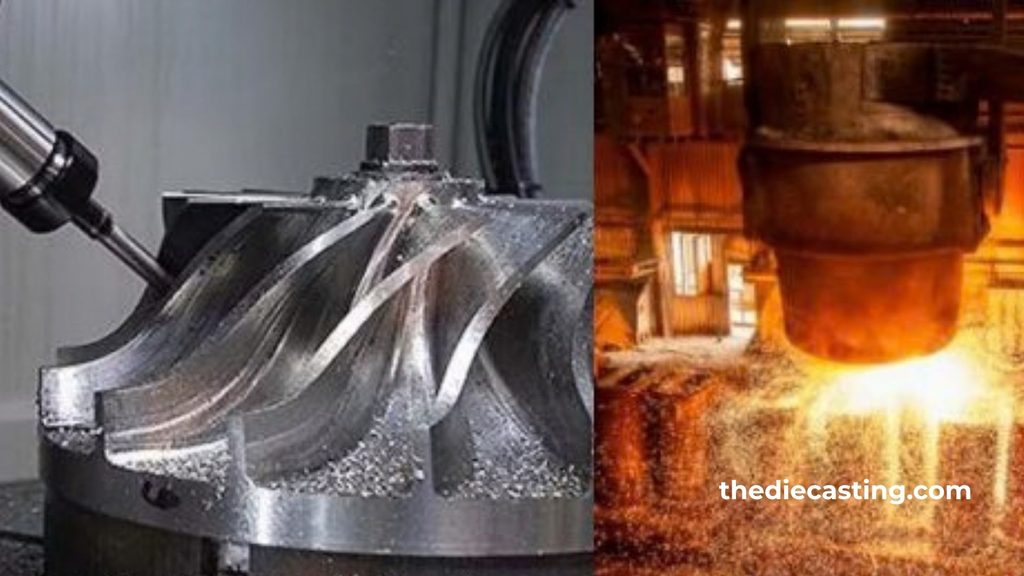
The first step in die casting is to choose and melt an appropriate metal or alloy. The molten material is poured or injected into a mold that has been built up around the shape of the component. Once cooled and solidified, the part is taken out of the mold.
Other operations may be required as part of the process, such as trimming gates and runners, cleaning, heat treatment, surface finishing, inspection, and machining.
How Does CNC Machining Work?
Computer-assisted manufacturing is the process of cutting materials from a solid block of material. CAD model is translated into manufacturing instructions, frequently via CAM software. The CNC machine works with a set of toolpaths to create a shape with the correct features and dimensions.
The following are common CNC operations:
- CNC milling: Rotating cutting tools remove material to form flat surfaces, slots, pockets, and complex contours.
- CNC turning: The part spins while it is being cut in a cylindrical manner.
- Forare: Drills holes with a rotating drill.
- Boring: Increases or cleans holes to the desired dimensions.
- Reaming: Finishes holes to improve accuracy and surface quality.
What Is Casting Machining?
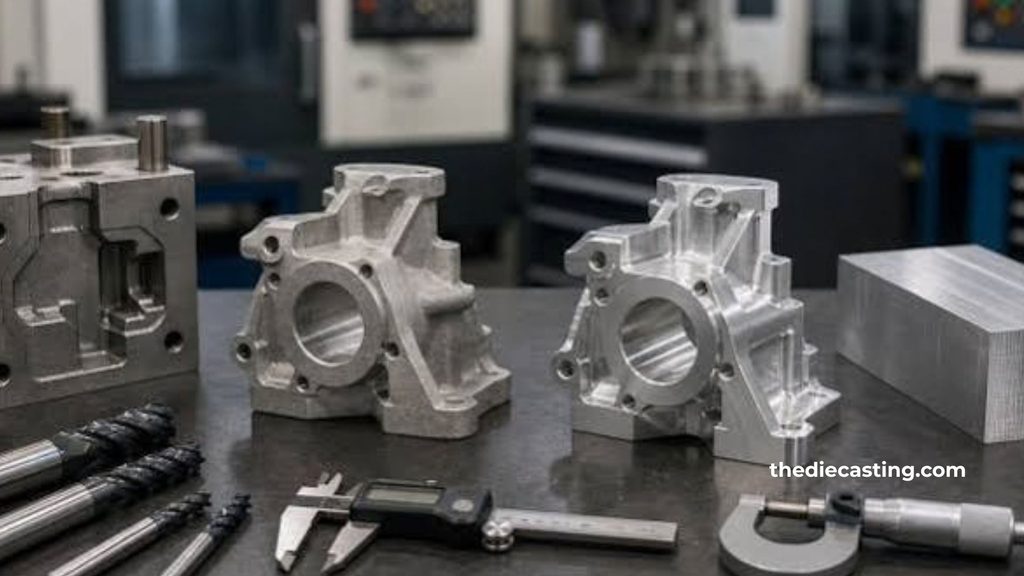
The casting machining method, also known as cast and machine manufacturing, is a combination of casting and CNC machining. The casting process is used to form the basic shape of the component, while selected features are given a surface finish and/or dimensional accuracy through machining.
For instance, a metal (Aluminium) casing can be cast, covering the whole body, ribs, and contours. The CNC machining processes can then complete the task of mounting faces, threaded holes, bearing seats, and other critical parts.
How Does the Casting Machining Process Work
Part design: Engineers design the part, considering the casting requirements, machining allowances, material properties, and tolerances.
Mold preparation: A mold is designed based on part design and casting technique.
Turnare: Molten metal is poured or injected into a mold and solidified.
Removal and cleanup: The solidified portion is removed, and excess material like gates, runners, or flash is cut off.
Inspecție: Defects, dimensional variation, and suitability for machining are checked in the casting.
Prelucrare CNC: Critical surfaces and features are milled, turned, drilled, or otherwise finished.
Benefits of Combining Casting and Machining
| Benefit | Explanation |
| Design flexibility | Casting forms complex shapes, while machining refines functional features. |
| Improved precision | CNC machining can achieve tighter tolerances on selected surfaces. |
| Reduced material removal | Casting creates much of the part’s shape before machining. |
| Better component fit | Machined holes, seats, and mating surfaces support accurate assembly. |
| Production efficiency | The combination can balance casting productivity with machining precision. |
What Are the Four Types of Casting?
There are four major casting techniques: sand casting, die casting, investment casting, and squeeze casting.
1. Turnarea în nisip
Sand casting is a process that utilizes specially prepared sand to form a mold. A space is created in the mold that corresponds to the shape of the component. The molten metal is poured into the cavity, cooled down, and then removed by breaking the sand mold.
Key characteristics:
- Appropriate for a variety of metal alloys.
- Is able to create large components and complex shapes.
- Uses relatively cost-effective mold materials.
- Generally results in a less refined surface than precision casting processes.
- Typically requires a new mold for each casting.
2. Turnare sub presiune
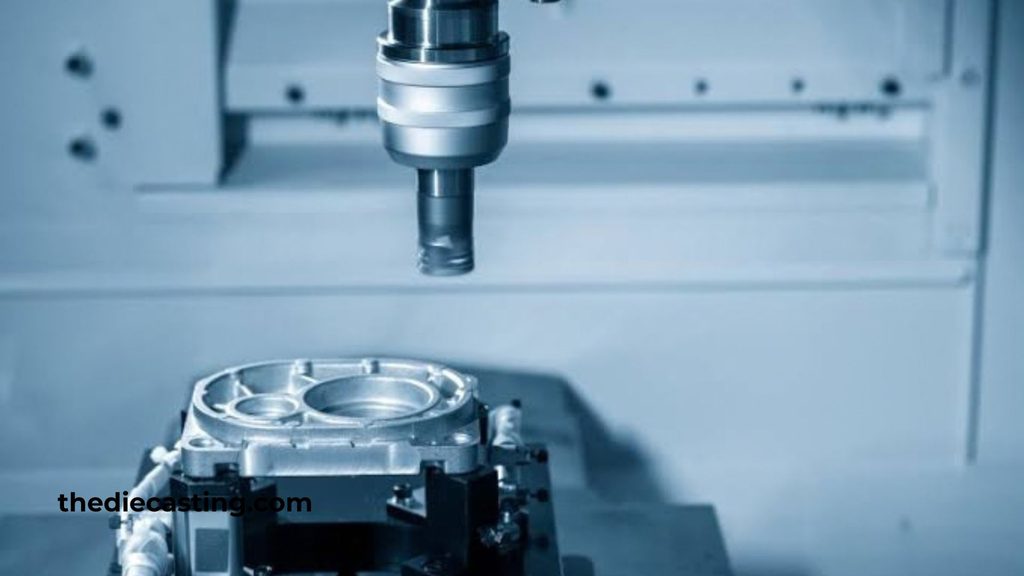
In the turnare sub presiune process, molten metal is pushed into a reusable metal mold (die) under pressure. After the metal cools, the die opens up, releasing the part.
Key characteristics:
- High production rates.
- Good repeatability with controlled processing.
- Is able to generate thin walls and intricate models.
- High-volume production is possible with reusable dies.
- The type of alloy used is dependent on casting and component requirements.
Hot-Chamber and Cold-Chamber Die Casting
| Caracteristică | Hot-Chamber Die Casting | Cold-Chamber Die Casting |
| Metal delivery | Molten metal is held in an integrated furnace system | Molten metal is transferred into the injection chamber |
| Typical materials | Lower-melting-point alloys, such as zinc | Higher-melting-point alloys, commonly aluminum |
| Cycle | Generally faster for suitable alloys | Includes additional metal-transfer steps |
| Echipament | Injection components operate in contact with molten metal | Injection system is separate from the holding furnace |
| Aplicații | Small zinc components and fittings | Aluminum housings and structural parts |
3. Turnare de investiții
Lost-wax casting, or investment casting, is a technique that involves making a detail mold from a disposable wax pattern. The pattern is coated and covered with a refractory material, which will create a ceramic shell.
Key characteristics:
- Appropriate for complex forms and details.
- It can make reasonably smooth surfaces.
- It can be used to minimize extensive manufacturing operations.
- Works with a variety of metal alloys.
4. Squeeze Casting
Squeeze casting is the blending of aspects of casting and forging. Molten metal is fed into a die and pressure is applied during solidification.
Key characteristics:
- The pressure is maintained through solidification.
- This process will create low-porosity components.
- It will enhance mechanical properties in comparison with some conventional casting procedures.
- Needs special equipment and controlled processing.
- The costs for the tooling and the process may be higher than simpler processes.
Casting vs. CNC Machining: Which Process Should You Choose?
When to Choose Casting:
- The component is a complex part or hollow.
- Large quantities of similar parts are required.
- The casting method can be used to obtain the required dimensional and surface requirements.
- The material and geometry are suitable for the process.
- The cost of tools can be spread over a reasonable production volume.
When to Choose CNC Machining:
- The project is a prototype or small number of production runs.
- Close tolerances are required.
- The design will be subject to change in the course of development.
- The component needs precision holes, slots, threads, or mating surfaces.
- The part can be manufactured from existing stock material, with low production cost.
When Is a Combined Process Appropriate?
For parts with complex overall shape but a requirement for precision functional features, cast and machine production might be appropriate.
An industrial pump housing, for instance, can be cast to form the main housing and internal passages. CNC machining can then be used for final assembly of faces, holes in the shafts, and seal surfaces. This can minimize the amount of milling from solid and still maintain precision in areas where it is required.
Is CNC a Hard Job?
CNC machining is not particularly difficult, but the level depends on the job, machines, complexity of the parts, and responsibility. Different skills are required by the different people involved in a CNC operation, as well as setup and programming, and manufacturing engineers.
- Blueprint Reading: Reading engineering drawings, dimensions, tolerances, and geometric specifications.
- Measurement: Checking dimensions using calipers, micrometers, gauges, and inspection tools.
- Machine operation: Loading workpieces, selecting tools, monitoring cycles, and following safety procedures.
- Tool knowledge: Understanding of cutting tools, tool wear, work holding, and machining parameters.
- Programming: The creation or modification of CNC programs (G-code or CAM software) as appropriate.
What Makes CNC Machining Challenging?
With CNC machining, it’s not just about operating a machine. Workers need to be aware of the influence of material characteristics, cutting forces, tool geometry, machine rigidity, and machining parameters on the finished product.
Typical problems include tight tolerances, selecting proper tools, avoiding chatter and excessive tool wear, setting up the workpieces accurately, troubleshooting surface finish problems, and safety procedures.
Common Casting Defects and the Role of Machining
Casting defects can affect a component’s dimensions, appearance, or mechanical performance. Identifying and controlling these defects is an important part of manufacturing quality.
| Casting Defect | Descriere | Potential Impact |
| Porozitate | Small cavities or voids within the casting | May affect strength, sealing, or pressure integrity |
| Micșorare | Cavities or dimensional changes caused by contraction during solidification | Can compromise structural integrity or dimensions |
| Warping | Distortion during cooling or solidification | May cause alignment or dimensional problems |
| Surface cracks | Cracks that develop on the casting surface | Can affect durability and acceptance |
| Includeri | Non-metallic materials trapped within the casting | May reduce material quality and performance |
CNC machining can correct certain dimensional variations and refine surfaces, but it cannot automatically eliminate internal defects or restore compromised material integrity.
How to Reduce Costs in Casting and CNC Machining
The manufacturing costs are dependent on the part design, material, production volume, tooling, machining time, and quality requirements. The following are examples of practices to help control costs:
- Choose the process early: Assess the casting, machining, and combined manufacturing during the design phase.
- Discuss material requirements: Select an alloy according to mechanical requirements, working conditions, and manufacturability.
- Do not overcomplicate geometry; simplify as much as possible as long as it retains its functionality.
- Use functional tolerances: Only use tight tolerances where necessary.
- Design machining allowances: Ensure adequate stock on cast surfaces to be finished.
Întrebări frecvente
What is the difference between casting and machining?
Machining is a process that uses cutting tools to remove material from a solid material, and die casting involves pouring molten metal into a mold. The die casting process is often employed for complex shapes and large production volumes, while machining is typically chosen for precision features and flexible production.
What is a casting machine?
Casting machining, also known as “cast and machine” manufacturing, is a combination of casting and CNC machining. The main shape is made with casting, while critical dimensions, holes, surfaces, and functional features are developed with machining.
Is CNC machining a hard job?
CNC machining is difficult, as it involves understanding engineering drawings, measurement, machine operation, tooling, and in some cases, programming. Technical training and supervised practice are a way for beginners to learn.
Does casting cost less than CNC?
Die Casting might be more economical for suitable high-volume production because the costs of tooling are spread across a number of parts. CNC machining could be more cost-effective for prototypes, small runs, or high-precision parts. The optimal process is based on part requirements and production volume.
Can cast parts be CNC machined?
Yes. Accurate part dimensions, surface finish, and precision features like holes, threads, bearing seats, and mounting surfaces are typically created by CNC machining of cast components.
What is the best casting technique to capture detailed information?
Investment casting is generally applied for intricate geometries and intricate details. This is dependent upon material, part size, part design, tolerances, and volume.
Concluzie
Casting and CNC machining are both essential in metal manufacturing but do so in different ways. Casting involves the production of forms from molten metal into a mold, suitable for a variety of complex shapes and production operations.
CNC machining is a tooling method that cuts or shapes a solid material into a desired shape and size. Each of the following casting methods has its own set of abilities and drawbacks: sand casting, investment casting, and squeeze casting.
Cast and machine manufacturing can be used together to take advantage of both techniques for components with complex geometries and precision. The proper selection involves considering geometry, material, tolerances, surface finish, production quantity, quality requirements, and overall cost.