
Modern manufacturing uses aluminum in almost every application. It is used in the automotive industry, electronics, machine parts, window frames, heat sinks, housing, cookware, and more. This frequently leads to a simple question: What is the difference between aluminum and die-cast aluminum? The answer is that Aluminum is the metal, and die-cast aluminum is aluminum formed through a specific casting process.
Not all aluminum products have the same composition or properties. Manufacturers mix various elements into pure aluminum to make different alloys because aluminum is soft. Manufacturers then subject the alloys to various manufacturing operations such as rolling, extrusion, forging, machining, sand casting, and moulage sous pression.
Thus, if a part is made from aluminum, knowing only that information is not enough to determine how it was formed. So it’s more commonly a comparison of wrought aluminum to die-cast aluminum. Wrought aluminum is solid aluminum that is shaped by mechanical means. Die-cast aluminum is produced by injecting molten alloy at a high pressure into a metal die. These differences affect strength, shape, surface finish, manufacturing cost, tolerances, and suitability for different applications.
What Is Aluminum?
Aluminum is lightweight and has good corrosion resistance, thermal conductivity, and electrical conductivity. Most engineering products use aluminum alloys because pure aluminum is relatively soft. Alloys are aluminum mixed with other elements, which alter the metal’s properties.
For instance, 6061 contains magnesium and silicon and is used in structural parts, frames, machinery, and machined parts. 6063 is used for extruded profiles and architectural products, partly because of its good surface finish. 7075 is a high-strength alloy that contains zinc, magnesium, and copper.
The manufacturing method also affects the final properties
A good aluminum billet could be:
- Rolled into sheet or plate
- Extruded into a profile
- Forged into a high-strength component
- Machined into a precise part
- Cast into a mold
All these processes start with aluminum, but the products differ.
· Aluminium forgé
Wrought aluminum is an alloy shaped as a solid material. Common processes include rolling, extrusion, and forging. In these processes, the metal undergoes controlled deformation. As the material forms, its grain structure changes, which can improve strength and ductility in wrought alloys.
Extruded aluminum is used to manufacture long products with uniform cross-sections, including window frames, structural profiles, channels, tubes, and rails. Forged aluminum offers strength and resistance to repeated loading. Aluminum hot forging, for instance, involves heating and compressing hot stock under high force rather than pouring it into a mold to form a shape.
· Aluminium moulé
Cast aluminum products are aluminum alloy parts formed by pouring or injecting molten aluminum alloy. There are several ways to cast. Aluminum casting includes sand casting, gravity casting, permanent mold casting, investment casting, and pressure moulage sous pression.
The choice depends on the part geometry, production volume, desired properties, tooling cost, and surface specifications. Die casting is one particular type of casting. Under high pressure, molten aluminum alloy is fed into a metal die cavity and fills it rapidly. As the metal cools, the die opens, and workers remove the part.
What Is Die-Cast Aluminum?
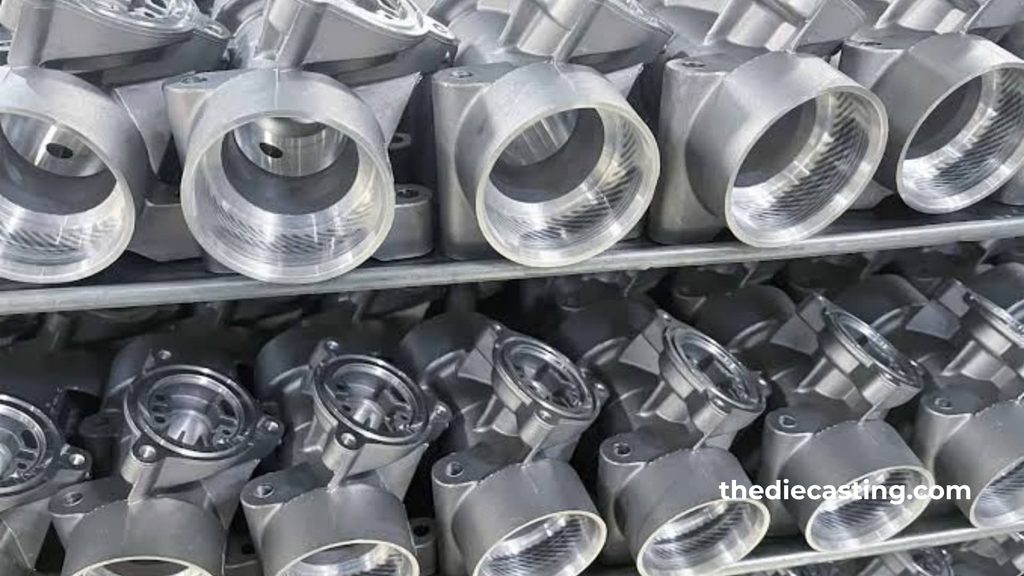
Die-cast aluminum is an aluminum alloy produced through high-pressure moulage sous pression. The process begins with aluminum alloy ingots or other suitable feedstock. The alloy is melted and held at a controlled temperature. A casting machine then injects the molten metal into a steel tool at high speed and pressure. The tool contains the cavity for the finished part.
After the metal fills the cavity, the part starts to solidify. The die opens, and workers remove the casting. Workers trim away extra material from runners, gates, and flash.
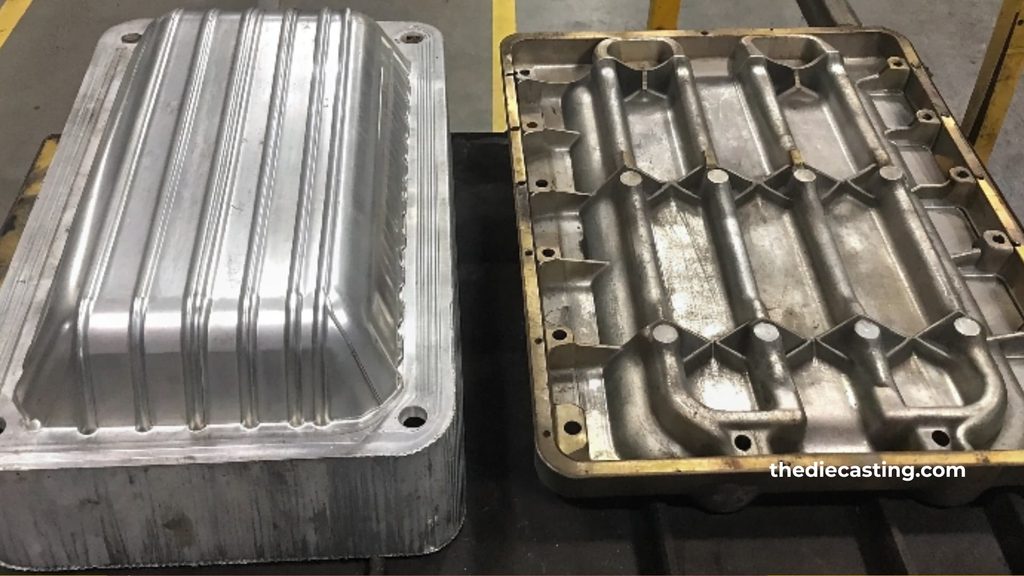
A die-casting mold is designed around the part geometry, material flow, cooling requirements, ejection system, and expected production volume. This process is especially useful for producing large quantities of parts with repeated dimensions and complex shapes.
Common die-casting alloys include ADC12, A380, A360, and several other aluminum-based alloys. These alloys contain more alloying elements than many common wrought grades. Silicon is especially useful because it improves fluidity and helps molten metal fill thin and detailed sections.
Aluminum vs Die-Cast Aluminum: What Is the Main Difference?
The biggest difference is not simply the word “aluminum.” The real difference is how the aluminum alloy is processed and shaped. Wrought aluminum starts as solid stock and is mechanically shaped. Die-cast aluminum starts as molten alloy and is forced into a metal cavity.
This difference affects grain structure, available shapes, mechanical properties, production speed, and cost.
| Facteur | Aluminium | Die-Cast Aluminum |
| Starting form | Any piece of solid billet, sheet, plate, bar, or extrusion | Molten aluminum alloy |
| Main processes | Rolling, extrusion, forging, machining | Moulage sous pression |
| Common alloys | 6061, 6063, 6082, 7075 | ADC12, A380, A360 |
| Shape range | Ideal for profiles, plates, tubes and machined shapes | Best for complex 3D parts |
| Thin walls | Possible, depending on process | Well suited to thin sections |
| Volume de production | Low to high | Best suited to medium and high volumes |
| Outillage | Often lower for simple shapes | Higher initial tooling cost |
| Porosité | Very low in sound wrought stock | Some porosity risk from casting |
| Secondary machining | Often higher | Often lower |
| Typical products | Frames, shafts, plates, brackets | Housings, covers, brackets, motor parts |
Why Die Casting Is Used for Complex Parts
The main advantage of die casting is its ability to produce complex shapes. Producing the part from a solid aluminum block may require multiple manufacturing processes, such as adding bosses, ribs, mounting features, curved surfaces, and thin walls.
A single production cycle can produce the same basic geometry on a die-casting machine. This saves material and shortens machining time.
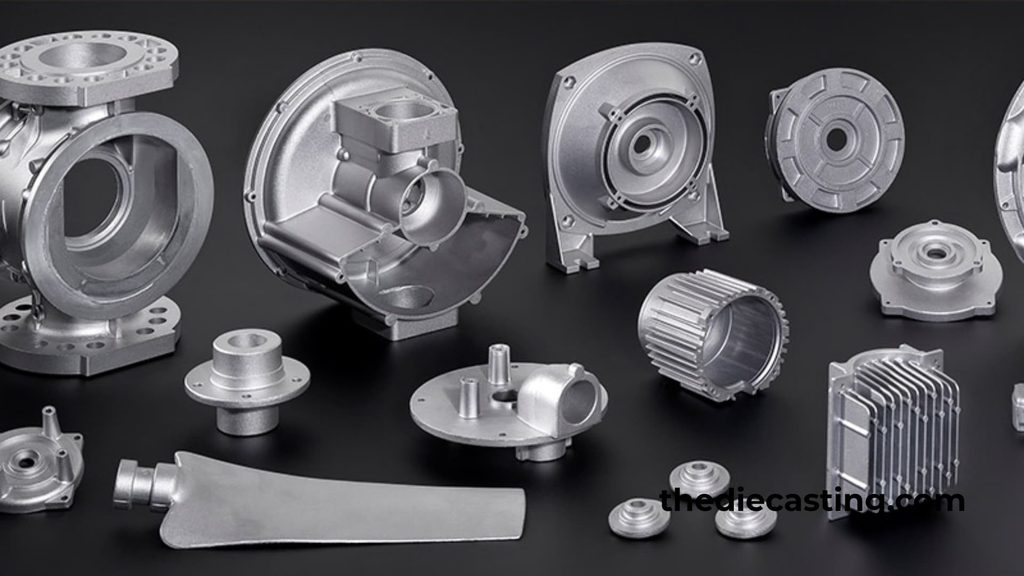
Die casting also achieves good repeatability. Once the tool and process are established, a manufacturer can produce numerous similar components of similar size. This makes it useful in the automotive industry for components, electronic housings, lighting bodies, motor housings, industrial equipment, and consumer products.
· Where the Tooling Comes In
One of the highest upfront costs in die casting is steel tooling. A die-casting mold consists of a cavity, runners, gates, cooling channels, slides, an ejector system, and other features needed to create the part.
Before manufacturing, the tool must be carefully designed to ensure it is suitable. The tool should be designed carefully before manufacturing. Wall thickness, parting lines, ribs, bosses, undercuts, metal flow, and draft angles influence the final product. Poor tool design can cause short fills, porosity, flash, distortion, tool wear, and ejection difficulties.
Manufacturers often conduct a design-for-manufacturing review before making tooling to ensure they can produce the product.
How Strong Is Die-Cast Aluminum?
This question requires a little care, as the term “aluminum” refers to many alloys and processes. Not all die-cast aluminum parts are necessarily weaker than all wrought aluminum parts. This comparison depends on the alloy, temper, casting process, heat treatment, part shape, and loading conditions.
The yield strength and elongation of wrought alloys like 6061-T6 may exceed those of some common pressure die-casting alloys, like ADC12 or A380. Die-cast alloys, however, are suitable for housings, brackets, covers, motor parts, heat sinks, and many other parts for good strength.
· What Is Porosity?
Porosity is the small holes within a casting. Air or gas may become entrained in the molten metal during fast injection and solidification. Shrinkage during solidification can also cause internal voids.
Not all porous parts are necessarily unusable. Process control, proper alloy selection, vacuum-assisted casting, appropriate wall thickness, and good tool design can minimize it. If parts need to be pressure-tight or have high structural performance, choose a casting method that meets those requirements.
One application where reducing trapped gas is important is vacuum die casting.
How Does Surface Finish Compare?
Die-cast aluminum surfaces are relatively smooth because the molten metal conforms to the shape of the steel die. The final appearance depends on the tool surface, alloy, casting parameters, trimming, and any finishing operations.
Another advantage of aluminum is good surface finishes, especially when extruded and machined. Various finishing options are available for both types of aluminum products. Common options include:
- Anodisation
- Revêtement en poudre
- Peinture
- Polissage
- Grenaillage
- Usinage CNC
- Placage
Each die-cast alloy will behave differently when finished in various ways. Alloy composition matters.
Which One Costs Less?
There is no single answer, since the calculation changes with production volume. For prototypes, small quantities, simple shapes, and parts already available as standard profiles or sheets, aluminum can often be a good choice.
Up-front tooling costs are high for die casting. However, the cost per part generally decreases as production volume increases once the tool is ready. When producing thousands or hundreds of thousands of the same parts, die casting can be more cost-effective.
| Production Need | Right Choice |
| One-off prototype | Machined aluminum |
| Small batch | Machined or gravity-cast aluminum |
| Simple long profile | Extruded aluminum |
| High-strength structural part | Wrought aluminum or forging |
| Complex housing | Die-cast aluminum |
| High-volume brackets | Die-cast aluminum |
| Large simple casting | Sand or gravity casting |
| Tight local dimensions | Tight local dimensions |
The choice should be based on the part and not just the material name.
Common Applications of Aluminum
Wrought aluminum is used in products where strength, low weight, corrosion resistance, or a specific profile matters.
Typical examples include:
- Cadres de fenêtres et de portes
- Structural profiles
- Aircraft components
- Cadres de bicyclettes
- Échangeurs de chaleur
- Pièces de machine
- Automotive suspension components
- Shafts and brackets
- Plates and panels
The exact alloy varies by application.
For instance, 6061 is used for general structural and machined parts, and 7075 is used for applications that require higher strength.
Common Applications of Die-Cast Aluminum
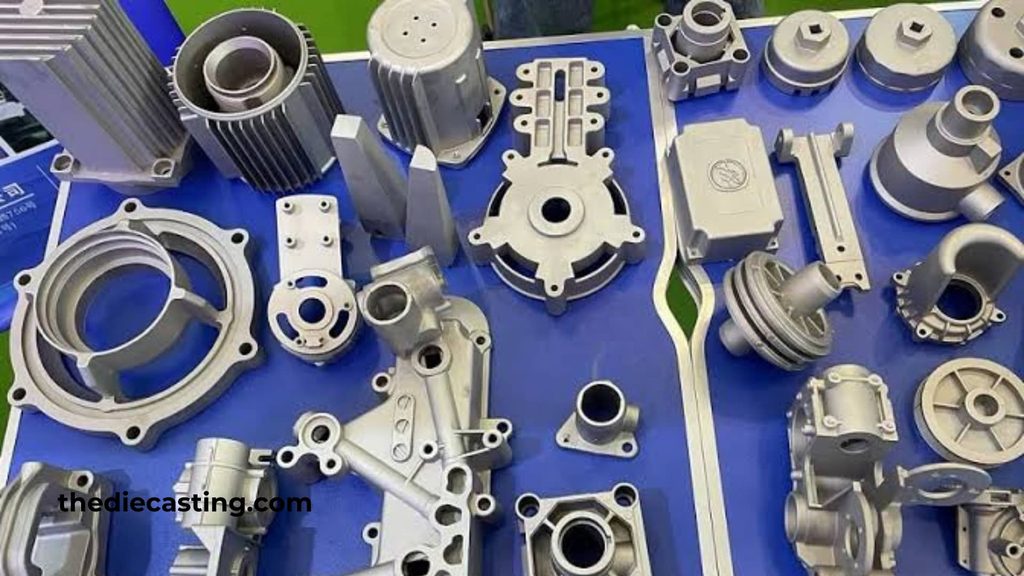
Products with complex geometry and high-volume production are commonly made of die-cast aluminum.
Typical applications include:
- Automotive housings
- Transmission covers
- Boîtiers de moteur
- Gearbox cases
- LED light housings
- Electronic enclosures
- Dissipateurs de chaleur
- Industrial equipment housings
- Pump bodies
- Supports
- Appliance components
The process also applies when multiple features are integrated into a single part.
For instance, a housing can have mounting bosses, ribs, screw holes, cable openings, and cooling fins all cast in the same piece.
What Should Manufacturers Choose?
First, define the part requirements.
When the part is simple and requires a long, uniform profile, then extrusion may be more suitable. A wrought alloy or forged part may be more suitable if the part must withstand repeated loads and requires high strength.
The more features the design incorporates and the greater the production volume, the more attractive die casting becomes.
The following questions help to narrow down the process:
· How complex is the part?
Aluminum is often easier to form into simple plates, bars, tubes, and profiles. Complex housings and brackets are good die-casting candidates.
· How many parts are needed?
Sometimes a few dozen parts don’t justify the investment in die-casting tooling. When producing large quantities, it is easier to divide the tool cost among individual components.
· How much strength is required?
For high loads, impact, fatigue, or safety-related applications, engineers should use actual alloy and process data rather than the general term “aluminum.”
· Does the part need pressure tightness?
If the component contains fluid or gas, pay close attention to porosity. Vacuum die casting, proper alloying, and leak testing may be necessary.
· How much machining is acceptable?
Die casting yields a near-final product, but holes, sealing surfaces, threads, and tight tolerances typically require CNC machining afterward. When using an aluminum plate, bar, or billet, you also need to machine the material.
Conclusion
Aluminum and die-cast aluminum are not two completely different metals. Aluminum is the base metal and the name for a large family of alloys. Die-cast aluminum refers to aluminum alloys cast under high pressure. When strength and ductility are important, aluminum is a good material for profiles, plates, machined parts, and components. Die-cast aluminum is used for complex shapes, thin walls, integrated features, and high-volume production.
For manufacturers, it is a choice of parts, not material names. Extrusion may be the best method of creating a simple profile. A high-load component may suit forging or other wrought processes better. Die casting may be a better option for a complex electronic housing. Prior to production, review the design for wall thickness, draft, parting lines, machining requirements, alloy selection, tolerances, and production quantities. A well-designed die-casting mold then helps convert the approved design into consistent production parts.
Typical steps for companies transitioning from CAD files or physical samples to production include: DFM Review, Tooling Design, Mold Manufacturing, Sample Approval, Production, Finishing, Inspection, and Assembly. Making the right decisions before tooling starts will save the cost of changing later.